Sunday, March 24, 2013

Covers for Books I've Never Written


When working on a new book, sometimes I need to stop and think things through for a bit.  If it’s something I plan on independently publishing, I’ll often work on a mock-up of the cover art as I turn things over in my mind.  However, as most authors can attest, some books just kind of fizzle out.  Maybe the timing for that particular work wasn't quite right and it will be revisited in the future or perhaps the initial excitement for the project waned.  Or, as is most often the case, I simply get swept up in another idea.  Because of these parts of my writing process, I’m left with a handful of covers for books I never actually finished writing.  Perhaps some day I really will come back to some of these ideas. Perhaps not.  Regardless, some of this left-over artwork is shown below, along with a brief description of what the book was to be about.


I started Albatross four years ago, but never really made it that far into the story.  It was intended to be a web serial with eventual print run once the plot had run its course.  The story centered around Albert Ross, a man charged with caring for his terminally ill mother.  Caretaking can be emotionally and physically exhausting at times and I wanted to set a character in that role who was ill-eqipped to actually handle it.  To exacerbate matters, his mother was to be a mean and spiteful old woman with a persecution complex who took some sort of sick glee out of pushing her son’s buttons.  This was to be a novel of human darkness and would not have ended well for any of the characters involved.  While working on this blog post, I found that the original chapters are still out there on the web.  Any interested parties can check it out here 


Drug Slaves of Satan was an attempt to write a horror novel in the style of a 1930’s propoganda film.  Drawing from inspirations such as Reefer Madness and Devil’s Harvest, I’d wanted to throw in a supernatural element as well.  The story was to center around a clean-cut, all-American teenager whose older brother was pulled into a world of sex, drugs, and black magic.  When the older brother was found sliced to ribbons in a dumpster, the younger boy begins to emmulate the behavior of his deceased sibling in a misguided attempt to figure out exactly what happened.  This is one I may very well return to at some point, perhaps with a different title though.


A Feast of Fools: The Cannibal’s Cookbook was to be a novelization of my short story Cooking With Grace.  The novel was to be told entirely through letters, emails, articles, recipes, and transcripts.  The short story (which followed this formula) was to be the first chapter in the book and the book was going to be a collaboration with my wife.  To further expand the story, I’d actually set up email accounts for every email address referenced within the original short story.  These accounts were then equipped with auto-responders.  Anyone curious enough to send an actual email to the addresses in the story would then get a reply from the character they were emailing, which I thought was a great way to expand the universe beyond the pages of the book.  I’d also planned on doing webisodes of a cooking show where I would be masked and playing the role of the serial killer/cannibal, which I think would have been a lot of fun.


The Curse of the Walking Dead was to be the first book in a series of Victorian-era steampunk novels featuring detective Bastion Folks.  Some of the characters from this book have really stuck with me over the years and I’m positive I will be exploring them in different works.  The most intriguing of these is the novel’s antagonist who goes by the moniker Lady Entropy.  Born into the upper-class, she turned her back on her country after her father was suspiciously killed while on an expedition funded by the Queen herself.  Vowing revenge, Lady Entropy’s sole purpose is to bring the government to their knees, even if it means destroying citizens in the process.  She is very prim and proper, given to wearing white, lacy dresses with lace-up leather boots, and her parasol is never far from her.  In one of my favorite scenes from what I’d actually written on this one, a laborer who has incurred her ire kneels before her.  Using the tip of her parasol, she lifts the man’s chin so he is looking directly into her eyes.  A lever on the parasol causes a spike to shoot out of the tip and into the man’s throat;  as she withdraws the weapon, the umbrella-portion deploys, shielding her clean clothes from the spray of blood which follows.  To date, Lady Entropy is my favorite villian that I’ve created.


Godhammer.  I have a feeling this one would have come to around novellas-size.  It was to be a dystopian tale, set after a series of events had crumbled the infrastructure, permanently changing the United States as we know it.  The madman who seizes control blames organized religion for every problem the old world knew and outlaws them all.  In their place, he calls for new religious orders which causes cults to spring up left and right.  The vast majority of the population has aligned themselves with one cult or another since that is the easiest way to gain supplies and protection.  Those who have not pledged their allegiance to a faction are bombarded with propaganda from the various cults and in a world where there is no regulation of the recruitment methods things can go bad very quickly.


Vigilante Messiah was to be a story about a homeless man and possible paranoid schizophrenic who finds a Jesus outfit in a dumpster behind a costume shop that’s gone out of business.  He lives in an old, burnt out church on the outskirts of the city, between the railroad tracks and the riverbank.  After witnessing a woman get brutally killed, he returns to his “home” and starts a fire in a rusted fifty-gallon drum to keep warm through the night.  The fire, however, turns into a flaming pillar from which a voice booms out instructions.  The voice tells him that he is the avatar of Christ and the second coming is at hand;  he must go out into the world and cleanse it from evil, freeing the demon-possessed souls of thieves, rapists, drug dealers, and pedophiles.  There is a damn good chance I might come back to this one as I really like what I've completed on the book so far.


The Bugout Bag of Holding is one of those books where I don’t really know what I want it to be.  I know it’s a tale of a terrorist attack on a city.  I know it involves a prepper who has 72 hours to find her way out of said city, thus securing her safety.  I just don’t know in what world I want it to be set in.  My initial thought was in our world and the title would come from the fact that the protagonist would be an avid role-playing gamer.  However, I've also toyed with a different idea.  In this one, the world is similar to ours in a lot of ways;  however,  it would be set in a Dungeons and Dragons style reality where those campaigns were part of their history, much in the way Vikings are a part of ours.  The city would be urban and there would be a fusion of magic and technology at play with the prepper protagonist being a half-elf.  When this cover was created, I was still thinking the tale would be set in our world and if the woman in the gas mask looks familiar then you probably know her.  It’s none other than Joy Killar, who’d graciously given me permission to use her image.

Thursday, March 21, 2013

How Film Appreciation Changed My Writing


In my twenties, I thought for a while that I wanted to direct films.  I had a bevy of equipment:  8mm cameras, projectors, screens, a film splicer, video camera, editing deck, and titler.  During my freshman year of college, I was still torn however, unsure of whether to pursue a degree in film or English, so I chose electives which would be an introduction to both.  One of these classes was Film Appreciation. We would meet in the college’s theater every Thursday and the first half of class consisted of a lecture, after which we’d watch a movie which best exemplified the topic currently being studied.  We watched everything from Singing in the Rain to The Terminator to Ingmar Bergman’s The Seventh Seal. 

The topic which stuck with me most, though, was Mise-en-scene.   A French expression literally meaning “placing on stage”,  mise-en-scene is the art of composing a shot.   Before this class, I’d never given much thought to why particular props or actors were located where they were.  I’d just accepted the reality of the scene and flowed along with the plot, never realizing the subtle details at play.  In film, for example, things near the top of the screen usually carry a heavier weight and are thus more important than things at the bottom.  I can’t remember the film we watched as an example, but there was a scene with an argument between a man and a woman in it.  

When the scene began, the man was at the top of a staircase, glaring down at his companion, who stood at the bottom;  he controlled the argument at this point and had all the power, causing the woman to cringe at the bottom of the stairs (and thus, the screen), making her even smaller than what she already was.  Eventually, the woman had enough.  She charged up the stairs as he stormed down them to meet her.  Now they were both in the center of the screen and the argument was fairly balanced, each person making their point but no one really having dominance in the exchange.  Eventually the woman gained the upper hand and, uncertain how to proceed, the man stomped down the stairs, intent on leaving the room.  The woman, however, was having none of it.  She remained at the top and verbally controlled the argument, yelling down questions which flustered the now-powerless man at the bottom of the screen.

This, of course, was just one of the techniques we discussed.  We also learned how downward movement in film represents death (which is why it is raining in so many death scenes), how props can be used to both physically and symbolically isolate characters from one another, and so on. 

In the end, filmmaking proved too expensive for me… I simply couldn't afford all the things I required to create a world.  And, in all honesty, my passion for creating a story with words far outweighed my desire to create them with images.

These two interests, however, ended up merging.  I took what I’d learned about mise-en-scene and often apply it to my written works.  For example, there’s a scene in Apocalyptic Organ Grinder where the two antagonists (since I’m not really sure there is a protagonist in this book) are so close to one another their noses are nearly touching.  The scene is set at night and in the background, a torch burns in the darkness, filling the small gap between them.  This was meant to show the conflict raging between the characters, connecting them by something that can be all-consuming if left to its own devices.  At the end of Shadow of the Woodpile, Bobby was perched atop the massive mound of wood while Detective Maxwell and his parents stood below.  There are other examples of mise-en-scene in my work, but I think these will suffice.

Does anyone notice or even care that I apply film techniques to the written word?  Probably not.  But I’ve come to realize this is part of my personal style and I felt like writing a blog entry, so this was it.

Friday, January 25, 2013

The Princess of Blood Casts Out Demons: A True Story


December 31st, New Year’s Eve, around 11:15 PM or so.  I’d just finished my tour at the Remote Encoding Center, where I did data correction for the post office, and was anxious to get to a party a co-worker was throwing.  Stepping outside, however, was like walking into a snow globe.  Flurries blew continuously on a wind that chilled me to the very marrow of my bones and salt trucks rumbled along the streets of Charleston as driver’s cautiously followed behind; the gold dome of the capital building was dusted white and pockets of snow clung to street signs as if afraid of hitting the ground.  Turning my back to the breeze and cupping my hands, I lit the last of my cigarettes before trudging through the ice and accumulation to the gravel parking lot across the street.  For the most part, the streets were barren and stoplights cycled through colors at empty intersections while an ambulance wailed in the distance.

I knew I’d need a fresh pack of smokes before hitting the party, so I crept along a treacherous interstate with my heater and wipers on high as I hunched forward, peering through the tunnel of snow which rushed at the car.  Eventually, I found the exit I wanted and pulled into a little oasis of light where a Go-Mart sign shined through the storm.

Parking as close to the door as I could, I grabbed my wallet and had just taken the keys from the ignition when I saw her.  She was shorter than me and her hair was a disheveled shock of bleached blonde with dark roots just beginning to show through.   She was engulfed by a ratty, green sweater whose hems were frayed and a backpack whose straps were held together with duct tape sat by her feet.  She stood outside the plate glass windows, under the awning surrounding the convenience store but still exposed to the elements, and I remember thinking that something about her reminded me of a small animal that had been pushed from the car and left behind as a vacationing family sped away.

She was definitely a person of interest.  I wasn't attracted to her physically, but her general appearance and demeanor had snagged my writer’s curiosity.   However, when I went into the store, she barely glanced in my direction, continuing to pace along the sidewalk with her eyes intently staring at the scuffed tips of her tennis shoes.  I poured strong, black coffee into a Styrofoam cup, grabbed a couple candy bars to replenish the stash I always kept in my glove box, got my cigarettes and headed back out into the cold.

She was waiting just outside the doors and I strained to hear her mumbled words above the rumbling of engines from the gas pumps.  A truck stop.  She needed to get to a truck stop and did I know where one was.  Could I take her?  To the truck stop, before midnight.  Could I take her?
Desperation glinted in her eyes and she continually glanced over her shoulders every few words, as if fearing that someone was sneaking up behind her.  There were still approximately twenty minutes before the new year was rang in and I knew if I took this waifish girl to her destination I’d never make it to the party in time.  But something compelled me to agree, exactly what I can’t say.

In the car she told me her name was Princess, though she looked like anything but.  Her face was lean and gaunt with bloodshot eyes sunken so deeply into her skull that they seemed to be perpetually ringed in shadow.  Her thin lips were so dry that flakes of skin hung over painful looking cracks and a cold sore festered at the corner of her mouth.  She’d pulled her feet onto the seat as we drove and wrapped her arms around her legs as she slowly rocked back and forth.

They were after her, she said.  They would be looking for her and she needed to get far, far away from this town as quickly as possible, for she knew they would find her.  They always found her, no matter how fast and how far she ran, but she never gave up hope, never stopped trying….

She was a witch, she continued, from a lineage that could be traced back centuries.  Her family was plagued generation after generation by the very demons her ancestors had struck a pact with.  They whispered in her mind, lurked in the shadows of strange cities, and masqueraded as normal people.  They cackled and laughed when no one was listening and pulled her hair when she tried to sleep.  Once, she said, one had slithered down her throat while she was eating but she had chased it away with gasoline.

It was a stop and go monologue with short periods of silence punctuating sentence fragments which seemed to burst and tumble from her mouth.  She’d begun rooting around in her bag as she mumbled and prattled, eventually removing a prescription bottle and shaking a handful of white pills into her palm.  Without asking, she snatched my coffee and washed them down before leaning back against the headrest and closing her eyes.

When demons touch you, Princess explained, they always leave something behind.  Something they can use to track you down, to find you no matter where you go in the world.  But she’d discovered a secret, a way to give them the slip.

At some point she’d retrieved what appeared to be a small, beat-up vanity, though I missed where she actually got it from.  It clicked open and she then pushed up the left sleeve of her sweater, revealing a pale forearm ridged with scars.  With the windshield wipers slapping a breakneck rhythm in their war against slush and the radio no more than a lull, she removed something from that little vanity.  In the glow of the dashboard, I stole glances at her watching as she pinched half a razor blade between her thumb and first two fingers.  Without a word, she pulled the blade across an unblemished patch of skin and threw her head back, eyes half-closed, as her back arched; blood welled from the wound and trickled down her arm while a soft sigh escaped her parted lips.  For a moment, she seemed frozen in time, but then she smiled and put the razor blade back into its case.

She would be safe for a while, she whispered.  She’d purged their taint from her system and they couldn't find her, buying her time.

“Do you know about ritual magic?” she asked as she leaned closer to me, blood oozing across her skin and staining the fine hairs lining her arm.  In fact, I did… however, my instincts told me it was probably best not to divulge that bit of information, so we rode the rest of the way in silence.

I dropped Princess at a truck stop off the interstate on the other side of the city; through my rearview mirror, I watched her disappear into the swirling snow as I pulled away and whispered a blessing for her safety and well-being   I never saw her again, but have wondered over the years how her story played out.  I hope she was finally able to find peace but, of course, will never know.

True story.

Tuesday, January 22, 2013

IN PROGRESS GAME REVIEW: SOUL


Game: Soul

Developer: Kydos

Platform: Xbox 360, iPhone, iPod Touch

Genre: Puzzle

ESRB Rating: Unrated


Recently, I had a very bad case of the flu. Not just the common cold, mind you, but a flu blown flu that left me somewhat surprised I didn't come out on the other side as a flesh-eating zombie. When I got out of bed, I was usually greeted by a wave of vertigo and cold chills that tingled even my scalp. My joints felt like broken glass was embedded in the cartilage and I just couldn't seem to get the apartment warm enough. Because of this, I only got out of bed when absolutely necessary; I stayed beneath my comforter, alternately sleeping, watching movies, and playing video games. Which, of course, also meant I wanted a new game.  I wanted something new, but inexpensive; something I could easily put down when I started feeling super nasty and pick back up again later. But most of all, I wanted a challenge. Soul, from indie game developer Kydos, fit the bill nicely.

At the beginning of the game, a glowing ball of energy departs a corpse in a decrepit hospital. Your goal is to maneuver this soul through various corridors and scenarios as you try to guide it to Heaven. But there’s always a catch, isn't there? The passages you have to navigate may also, at times, be inhabited by what I think of as soul eaters. These black globs pop up from floors, ceilings, and walls, gnashing their teeth amid primordial roars. Get too close to one of these otherworldly creatures and your unfortunate soul is dragged to the depths of Hell, forcing you to restart the level.


Soul eaters aren't the only obstacles you have to contend with, however. Much like the classic board game, Operation, touching the borders is a definite no-no. Sometimes this forces you to use the utmost stealth on what appears, at first glance, to be a relatively easy level. There’s very little space between the ceiling and the soul eaters at times and progress is made through minute taps on the thumbstick.  Needless to say, you build up a sort of muscle memory with this type of stop-and-go level and caution quickly becomes second nature; the developers take full advantage of this, however, by immediately plunging you into the following stage, which is a race against rising water through a network of pipes.

At its core, Soul is a maze game. You start at Point A and have to somehow find your way to Point B in order to progress. The labyrinths are both challenging and unique; whether you’re making your way through a subterranean cavern with only your radiant glow to reveal surroundings or maneuvering through the grotesquely undulating intestines of a soul eater, the challenges so far have felt consistently fresh.


What gives Soul it’s true charm, however, is its dark atmosphere.The colors are very muted in this game, consisting primarily of washed-out looking earth tones. Walls are dirty and cracked, with hints of brick peeking through, and warrens of shadow cluster in corners. This lends a sort of comic-book noire feel to the environments, which jumps into the realm of horror with occasional pop-up scares.

The only thing working against this game is the fact that there’s no way to save your progress. If you exit Soul entirely, you’re forced to start over from the very beginning, replaying the same levels which you previously fought so hard to master. I’m not sure why the developers overlooked what should have been an obvious feature; if forced to hazard a guess, I suspect that maybe this may be a relatively short game and they felt no need to add extra code for something they expected people to finish in a single sitting. Even if that is the case, a save feature would've been nice. In fact, the lack of it is why I cannot, in good conscience, award Soul six out of six demons.

Everything else, however, is spot on... which is why it still comes out on top with an impressive 5 and a half out of 6 demons.


Sunday, January 20, 2013

Author Interview: Vincenzo Bilof

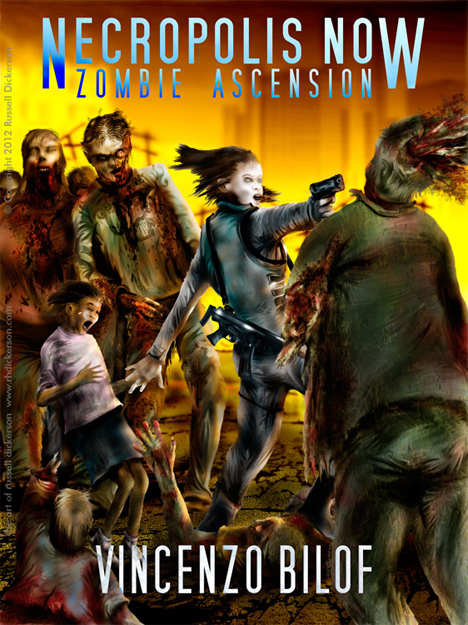
From Detroit, Michigan, Vincenzo Bilof is the recipient of SNM Horror Magazine's Literary Achievement award in 2011. Vincenzo is the author of the zombie novels "Nightmare of the Dead" and "Necropolis Now," the first book in the Zombie Ascension series. Both are available from Severed Press. Vincenzo's new serial, "Japanese Werewolf Apocalypse" will be available in February 2013. Please join me in welcoming this respected colleague to the blog.


As with my previous interviews, I’ll begin with the standard Six Demon Bag opening question, which you can interpret and answer however you please:  if you were in possession of a six demon bag, what would yours contain?

I would think the demons within the bag would be symbolic; each would represent a repressed or realized fear. If demons have the power to inflict suffering and pain, I imagine that I would have to experience six horrific scenarios, and in each I would be given a chance to "resolve" or prevent whatever disaster is supposed to occur, only to fail miserably.

With that out of the way, what can you tell my readers about your latest offering, Necropolis Now?

In Necropolis Now, the slow, Romero-esque zombies aren't the sole reason why Detroit is falling apart, but rather, mass hysteria perpetuates Detroit's destruction.  The central plot revolves around a former Delta Force commando who became a deranged serial killer in his quest for hellish power, which involves the resurrection of the dead; a group of mercenaries are dropped into the dying city to find him.

How long would it really take for people to say the word "zombie" if one of them appeared? Why do we have to use different words, like walker, when our first thought would be zombie? It wouldn't take long before people figured it out, if it happened, and the military wouldn't be overwhelmed. Rather, the people themselves would instigate society's destruction.  

Instead of using a cast of characters who are "good" people just trying to survive, I opted for characters that're already past the point of no return, characters that would wallow in the destruction rather than hide from it. In that way, my characters are very much like every day people…

People who watch The Walking Dead are witnessing the protagonist, Rick, slowly lose his "humanity" and become a more violent person. Most of the characters in Necropolis are where he doesn't want to be, and they're trying to reverse the process, or come to terms with WHAT they are. The book is truly about violence and redemption.

Necropolis Now is a fusion of styles. I grew up in the eighties, so I mixed over-the-top action with zombie gore and characters. It's Michael Bay meets George Romero.


A lot of your work deals with zombies… how do you think you’d fare if the undead apocalypse began tomorrow?

I think of it as a crises situation; there are a lot of similarities between an impending apocalyptic scenario and a natural disaster —the world as you know has been threatened and it may end. I say that because I don't want it to sound silly that I've actually thought about this. What would I do? I'm certainly not prepared. No ammo cache or grenades, and I don't exactly have Boy Scout skills. I like to think that in a crowd, I could make tough decisions for the good of the group, but with a child, I think the emphasis shifts, and the decisions are a lot more challenging. I would leave the katana swords at home, because the whole idea that it could slice through vertebrate like a hot knife through butter is about as ridiculous as a shotgun that never has to be reloaded… I would do anything to protect my family, so I would try to impose my will upon the group for my own personal gain, which would likely be bad. I think we would have to do things on our own, because I'd likely get kicked out…    


As human beings, our perceptions and experiences tend to shape our views of the world around us; as authors, we’re charged with creating our own worlds and populating them with people who never existed. Do you feel your own life experiences have influenced your imaginary worlds and, if so, how?

I think this is true of every writer, whether it's subconscious or realized. Our environment helps shape us, so our understanding of the world is often represented by our imaginary creations. I typically don't think of an archetype or someone I know when I create a character. I essentially meet my characters the first time I write them onto a page, and I learn more about them as I go, which often forces me to go back and edit things. I don't stop and wonder where certain concepts come from, but if I did, I could likely find a subconscious rationale behind everything.


In your opinion, what are the most important elements of good writing?

First, you must have an authentic voice. If I can pick up your book and it reads just like any other cookie-cutter Wal-Mart mass market book, or like a bestselling horror novel where the main character is always a fictional version of the author… it's kind of like forging a signature…

Second, take a grammar class. No, seriously—that make's me smile (joke). Many grammatical elements are thrown out the window when it comes to realistic character dialogue and stream-of-consciousness; good readers SHOULD be able to make that distinction, but if you break grammar rules — and this really applies to fragmented sentences and character language — you need to make sure you're consistently breaking them.

Third, take a psychology class. I'm actually going to write a blog post on this soon, but basically, you have to provide the reader with insight into WHO your characters are. Consider ensemble pieces like the TV shows American Horror Story or Game of Thrones. Intrinsic motivations and flaws inform character actions, and these are extremely important to the story.


Time for another standard Six Demon question:  There’s a train rocketing through the night with nearly a hundred people looking out the windows. The only person actually sitting in their seat is a small child who gazes unwaveringly at the floor. What is going on with these people?

The kid's parent tells them not to look, otherwise they would. Outside, Godzilla is stomping around and breaking stuff, and in its (hers?) hands there are a gaggle of late-night talk show hosts and politicians who suddenly have nothing clever to say because their writers aren't there to help them…

In one of your blog entries, you said, “I truly think that an exploration of horror can unlock the secrets of the human soul.”  Can you expand on exactly what you meant by this?

I'm going to begin to answer this question by quoting a mantra from Frank Herbert's Dune: "Fear is the mind killer…"
Fear cripples us. We’re all afraid of something, and it holds us back from discovering something important about ourselves, or the world. Change is the worst. The horror genre ultimately represents that. We hate it when our normal, boring lives are interrupted by a terrible inconvenience, like the car breaking down… or a traumatic event. It sets us back emotionally. It changes us.

There are so many horror stories that focus on children as the protagonists or the catalysts for horrific events. Why? They're supposed to be pure and innocent, untainted by the responsibilities and tragedies of the adult world. Orwell once wrote that "Ignorance is Strength." In a way, it is.

I think the horror genre is making a comeback, much to the chagrin of big publishers. We can open up Pandora's Box to discover what scares us. The things we're most afraid of represent inherent flaws in our society. Understanding what we fear helps us understand who we are; it allows us to deconstruct our personalities, to know the impetus behind out motivations and desires.

This is a discussion about what "horror" is, and there is a fine line between "horror entertainment" and "horror fiction." I guess I could write a book about this subject.


Speaking of writing books, if there were to be a novelization of your life what would the title be and who would you want to write it if you could pluck any author from the streams of time?

"I Told You I Don't Like Cake, So Please Stop Offering it to Me, Thus Forcing Me to Politely Decline Once Again." I think the title concisely summarizes my life. It would have to be written by Roberto Bolano, who actually wrote horror stories using poetry, so his stuff was sold as "literary" fiction. Most of his work involves madness and serial killers. He actually wrote a short story that was a summary of Return of the Living Dead 3, in which he tells you the plot of the whole movie; it's scarier than the film, and he didn't fluff it up.


We’re nearing the end now, so here’s the last of the standard Six Demon questions:  are there any questions you’d wished I’d asked but didn't?

You didn't ask me what I was having for dinner. I thought the whole world wanted to know… that's why I always post pictures of meals on Facebook.


You handled that last question with such grace and aplomb, that I’m going to leave the blog in your capable hands while I fight through the stray cats at the kitchen door in an attempt to take out the garbage.  Feel free to seize control.  Anything at all that you want to talk about or promote is fair game;  the forum is yours.  Ready…. GO!

If you enjoy zombies, EXPLOSIONS, gore, action, and complex characters, check out Necropolis Now: Zombie Ascension. It's the first book of a new series! Here's the synopsis:

Detroit has become a war zone. Slow, shambling corpses feast upon the living while fire consumes the city. Amparo Vega, a haunted mercenary, fights through streets that are choked with the dead. Her mission: extract the legendary soldier, Jim Traverse, who holds the terrifying secret behind the zombie epidemic. While the bullets fly, Traverse befriends a group of survivors whose fates are forever linked to his: an infamous arms dealer, a young lawyer, and a former detective struggle against the zombies together. Can Vega's elite cadre of mercenaries find Traverse before the epidemic becomes global? 

Thanks for your support! 

Friday, January 18, 2013

The Killer Within


The world of The Seven Habits can best be summed up in a line from the song Electric City by Firewater: “You don’t have to be a soldier to fight, but you better have a killer in ya.”   This is best exemplified by Ocean’s post-apocalyptic world.  No one who survives in these wastelands is weak; they can’t afford to be.  Life has been reduced to a bleak struggle for survival where you look out for yourself first, the people you care for second, and everyone else only as the situation dictates.  This hierarchy comes into play when Ocean kills her mother in a struggle over a dead rat.  In that situation, if Ocean had thought of her mother first, the young girl would have died then and there.  Her mother would have carried on with her life as if nothing happened.  Is it any wonder that Ocean’s father is dead?  He loved her very dearly and put her best interests before his own.  That’s not how you survive in that world.  But Ocean had what her father lacked, that killer within.  It possessed her just when she needed it most, enabling her to rip out her mother’s throat with her teeth and ensure her own continued survival.  Since she’s struggling to transition between childhood and what her world thinks of as  adulthood, she’s still conflicted at times.  This is why I’ve said Ocean will have to get progressively more calloused as the series progresses.  At heart, I think, she’ll remain a good person.  But there are a lot of hard choices in store for that young girl.

Much as Ocean is going through a rite of passage, so is Bosley.  His world is also in transition, but it’s at a stage where very few people have realized that there’s something intrinsically wrong happening.  Bosley knows, of course, because he’s been up and down this timeline so many times he’s got a birds-eye view.  He knows what’s going down.  But there are a handful of people out there who’ve noticed how a lot of their friends are changing, how it almost seems as if they’re slowly losing their minds, until one day they just erupt in a geyser of violence.  The virus is just now beginning to break the news and there are ripples of unrest among those connecting the dots.  The living dead, however, are not yet among those dots.  They're right around the corner, but at this point none one could have guessed what was to come.  Which is why the vast majority of them will not survive.  They’ll flinch when they should have struck without hesitation.  They’ll break down into extended states of shock, their brains overloaded by atrocities continually witnessed and too many surges of raw emotion.  They’ll allow old prejudices and preconceptions to dictate their paths toward death. Or any one of a thousand other reasons. This is the moment of change;  when each and every person has to reach deep down inside and find the killer lurking there or be devoured by the new reality. 

As a slight teaser, I’m attaching a link to the first chapter of book 2, The Dead Trap.  I think this may very well be one of the darkest scenes I’ve ever written, but keep in mind that this is extremely rough draft material.  It hasn’t been edited or polished in any way and needs refinement.  But it really sets the tone for book two and overall I’m happy with it.


Tuesday, January 15, 2013

In Progress Game Review: White Noise


Game: White Noise

Platform: Xbox 360

Developer: Milkstone Studios

ESRB Rating: unrated


So I finished the last game I’d been playing and was messing around on X-Box Live, browsing the indie games that are out there.  I admired some for what I thought were awesome titles along (‘Avatars Don’t Bleed’) and others for doing something a little different with a basic game concept we’re all familiar with. But then, one of these games really caught my eye.  White Noise.  I can’t even really say why it intrigued me.  The description was so mediocre that I can’t remember what it said and the screenshots they’d posted were only so-so.  Furthermore, there was no way to rally tell what type of game this was because the developers had elected the genre of Other.  Which, to be perfectly honest, might be what intrigued me right there.  But I digress.

White Noise was only 80 Microsoft points… pocket change left in the account from my last purchase, so I didn’t really feel like I’d be out anything if it truly sucked.  At less than 50mbs, it downloaded quickly and I was ready to play.

The first thing the game tells you is that to really enjoy the game to play it with the volume up and the lights out.  “Okay,” I said aloud, “I’ll trust you on this.”  Once I’d fulfilled those obligations, I sat down and really started to play.

The setup is straightforward:  you and your friend work for a paranormal magazine and have gone to a site in the woods for an investigation. You stay behind to set up cameras, while said friends goes outside to place the recording equipment.  He’s been gone for two hours, you’re worried, and decide the best course of action is to go out and look for him.  The premise also sounds fairly simple:  find eight tape recorders hidden in the woods.  Here’s where things get interesting.

From a first person perspective, you are surrounding by darkness and shadows.  The only things you can really see well are what’s illuminated in the glare of your flashlight.  A wind is howling through the trees and night insects chirp as your feet crunch with each step.  Sometimes ambient music drifts in and if you listen closely you can hear what almost sounds like a man screaming in the distance.  You pass some eerie landmarks along the way:  what appears to be some sort of Greco-Roman ruins, gigantic half buried statues, and a downright sinister looking bathroom area.

What impresses me here is that this game truly gives you the feeling of wandering through an unfamiliar forest in the middle of the night.  It pulls you in rather quickly, in fact, just by how genuine everything feels.  One button switches your flashlight on and off. You can press right trigger to sprint, but to do this your character has to drop the flashlight to his side;  meaning that you only get brief flashes of light from the bobbing camera as you run.   The only clues you have as to where the tape recorders are hidden are auditory.  Each one hisses with white noise and the closer to one you are, the louder it gets. If a loud hiss starts growing fainter, you know you’re heading away from your goal and have to readjust. 

As I was stumbling through the forest I saw what looked to be a human shaped shadow in the distance.  When I’d move, it would move.  When I stopped, it stopped. But it was always facing me.  And always just a little bit closer.  I approached it cautiously, circling and always making sure to keep it within the corona of my flashlight.  Bit by bit more details began to emerge and the effect of this part was downright creepy.
However, I can see how this game might get a little repetitive as you only have one life to try to find all eight recorders and there’s no such thing in White Noise as “taking damage”.  One shot is all you’ve got and if you fail, you’re right back at stage one.

So I’m going to hold an overall score for the time being and give just the atmosphere an impressive 6 out of 6 demons.  Stay tuned for updates.  My son has informed me that this game if a clone of another, called Slender, so I expect that might hurt the final rating in terms of originality, but as an introduction to this style of game it’s quite effective.